

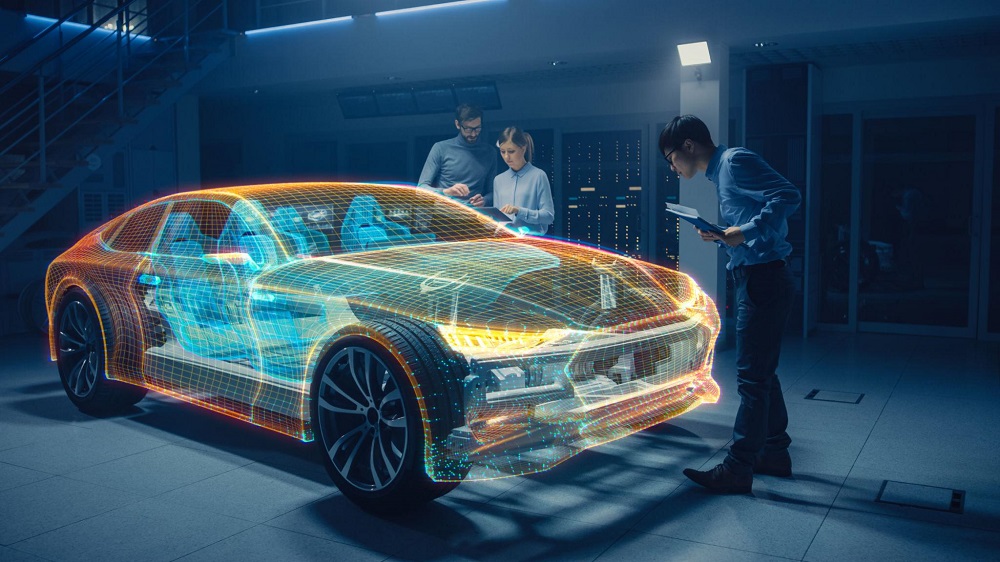
Vehicle development has become increasingly complex as manufacturers integrate electrification systems, advanced driver assistance technologies, connectivity platforms, and software defined architectures into modern automobiles. Traditional engineering workflows that relied heavily on physical prototypes are no longer sufficient to meet today’s speed, safety, and efficiency requirements. Digital twin technology is transforming the way automotive companies design, test, and optimize vehicles across the entire development lifecycle.
A digital twin is a virtual representation of a physical vehicle or component that continuously updates using real world data. Engineers use these digital models to simulate performance, predict failures, improve safety outcomes, and accelerate innovation cycles. As the automotive industry transitions toward smarter and more connected mobility platforms, digital twins are becoming central tools in modern vehicle engineering strategies.
Understanding how digital twins influence vehicle development helps explain their growing importance across automotive manufacturing ecosystems.
Understanding Digital Twins in Automotive Engineering
A digital twin is a dynamic virtual model that mirrors the behavior and condition of a physical asset in real time or near real time. In vehicle development, digital twins represent systems such as engines, batteries, chassis components, and entire vehicle platforms.
Digital twin models typically combine:
- engineering simulation data
- sensor generated performance metrics
- manufacturing process information
- environmental condition inputs
- operational usage patterns
These inputs allow engineers to analyze how vehicles behave under various scenarios without relying solely on physical testing.
Digital twin environments support faster evaluation cycles and improved decision accuracy.
Why Vehicle Development Requires Digital Transformation
Modern vehicles contain thousands of interconnected components supported by complex electronic systems and embedded software. Traditional development methods that depend heavily on prototype testing are increasingly time consuming and resource intensive.
Digital transformation supports vehicle engineering by enabling:
- faster prototype validation cycles
- reduced dependency on physical testing iterations
- improved cross team collaboration
- enhanced safety analysis capabilities
- accelerated product release timelines
Digital twin technology addresses these challenges by enabling continuous simulation throughout development stages.
Virtual modeling supports more efficient engineering workflows.
Improving Design Accuracy Through Virtual Prototyping
Virtual prototyping allows engineers to test vehicle concepts digitally before building physical models. Digital twins improve this process by simulating performance conditions across multiple design scenarios.
Virtual prototyping supports:
- structural performance analysis
- aerodynamic testing simulations
- crash safety modeling
- thermal system evaluation
- drivetrain configuration optimization
Testing these variables digitally reduces the need for repeated physical prototype construction.
Improved simulation accuracy strengthens early stage design confidence.
Supporting Electric Vehicle Battery Development
Battery systems represent one of the most critical components in modern electric vehicles. Digital twins help engineers analyze battery behavior under different operating conditions and usage patterns.
Battery development improvements include:
- monitoring temperature performance characteristics
- evaluating charging efficiency behavior
- predicting battery lifespan changes
- optimizing energy distribution strategies
- testing thermal management system effectiveness
Digital twin modeling improves battery reliability and safety outcomes.
Battery simulation supports faster innovation in electric vehicle platforms.
Enhancing Vehicle Safety Testing Through Simulation
Vehicle safety testing requires evaluating performance across many potential accident scenarios. Digital twins allow engineers to simulate crash conditions repeatedly without physical vehicle destruction.
Safety testing improvements include:
- collision impact modeling
- structural deformation analysis
- occupant protection simulation
- sensor response evaluation
- emergency system activation testing
Simulation based safety evaluation strengthens compliance with regulatory requirements.
Digital twins help engineers identify vulnerabilities earlier in development cycles.
Optimizing Aerodynamic Performance Using Digital Models
Aerodynamics significantly influences vehicle efficiency, stability, and performance. Digital twins enable engineers to simulate airflow behavior across different vehicle shapes and configurations.
Aerodynamic optimization supports:
- reducing drag coefficients
- improving fuel efficiency
- enhancing electric vehicle range performance
- stabilizing high speed handling behavior
- refining cooling airflow management
Simulation environments allow engineers to test multiple design variations quickly.
Aerodynamic improvements contribute to overall vehicle efficiency gains.
Supporting Connected Vehicle System Development
Modern vehicles rely heavily on connectivity features that support navigation, remote diagnostics, and advanced driver assistance systems. Digital twins help engineers evaluate communication performance across these integrated platforms.
Connectivity development benefits include:
- testing sensor network interactions
- evaluating communication latency performance
- monitoring system integration reliability
- validating software update workflows
- improving cybersecurity response planning
Digital twin platforms strengthen reliability across connected vehicle architectures.
Connectivity simulation supports smarter mobility ecosystems.
Improving Manufacturing Process Efficiency
Digital twins are not limited to vehicle design alone. Manufacturers also use them to optimize production line operations and improve assembly precision.
Manufacturing optimization benefits include:
- analyzing equipment utilization patterns
- predicting maintenance requirements
- improving workflow coordination
- reducing production errors
- optimizing supply chain synchronization
Digital manufacturing twins support more efficient factory operations.
Production optimization improves overall vehicle quality consistency.
Enabling Predictive Maintenance During Vehicle Lifecycle
Digital twins continue providing value after vehicles leave production facilities. Sensor data collected from vehicles in operation feeds into digital twin models that help predict maintenance needs.
Predictive maintenance advantages include:
- identifying early component wear patterns
- forecasting service requirements
- improving warranty planning strategies
- reducing unexpected breakdown risks
- supporting remote diagnostics capabilities
Lifecycle monitoring improves vehicle reliability and customer satisfaction outcomes.
Predictive maintenance strengthens long term ownership experiences.
Supporting Autonomous Driving Technology Development
Autonomous driving systems require extensive testing across diverse environments before deployment. Digital twins allow engineers to simulate millions of driving scenarios safely and efficiently.
Autonomous system testing improvements include:
- evaluating sensor perception accuracy
- testing traffic interaction behavior
- validating emergency response scenarios
- analyzing environmental condition variability
- supporting machine learning model training
Simulation environments accelerate autonomous vehicle readiness.
Digital twins improve safety validation efficiency for advanced mobility technologies.
Enhancing Collaboration Across Engineering Teams
Vehicle development involves multiple engineering disciplines working simultaneously on interconnected systems. Digital twin platforms support collaboration by providing shared simulation environments accessible across departments.
Collaboration improvements include:
- synchronized design evaluation processes
- improved communication between teams
- shared testing scenario development
- integrated software and hardware validation workflows
- faster iteration cycles across engineering functions
Collaborative platforms strengthen coordination across development stages.
Integrated workflows improve project efficiency.
Supporting Regulatory Compliance and Certification Testing
Automotive manufacturers must demonstrate compliance with strict safety and emissions standards. Digital twins help engineers simulate compliance scenarios before conducting physical certification testing.
Compliance support includes:
- emissions performance modeling
- safety regulation validation
- durability testing simulation
- component reliability evaluation
- environmental condition response testing
Simulation based compliance preparation reduces certification risk.
Digital twins improve readiness for regulatory approval processes.
Future Trends Shaping Digital Twin Adoption in Vehicle Development
Digital twin technology continues evolving alongside advances in computing infrastructure, connectivity systems, and artificial intelligence capabilities. Future developments are expected to expand simulation accuracy and integration across mobility ecosystems.
Emerging trends may include:
- stronger integration with real time vehicle telemetry systems
- expanded cloud based simulation platforms
- improved artificial intelligence assisted modeling
- deeper integration with smart manufacturing systems
- enhanced collaboration between suppliers and manufacturers
These innovations will continue strengthening digital twin applications across automotive engineering environments.
Digital twins are becoming essential tools for designing safer, smarter, and more efficient vehicles.
FAQ Section
What is a digital twin in vehicle development
A digital twin is a virtual model of a vehicle or component that mirrors real world behavior using simulation data and sensor information.
How do digital twins reduce vehicle development costs
They reduce the need for repeated physical prototype testing by allowing engineers to evaluate performance through simulations.
Are digital twins used only for electric vehicles
No. Digital twins support development across both electric and internal combustion vehicle platforms.
Can digital twins improve vehicle reliability after production
Yes. Operational sensor data helps predict maintenance needs and identify performance improvements throughout the vehicle lifecycle.
Do digital twins help accelerate autonomous vehicle development
Yes. Simulation environments allow engineers to test driving scenarios that would be difficult or unsafe to replicate physically.
How do digital twins support automotive manufacturing efficiency
They help optimize production workflows, reduce errors, and improve equipment utilization across assembly lines.
Will digital twin technology become standard in future vehicle engineering
Yes. As vehicles become more connected and software driven, digital twins are expected to play an increasingly important role in development strategies.

Comments are closed.